CLIENT
Michael Jonas / All American Why
ENGAGEMENT
Q3 – Q4 2025
SMG ROLE
Show Development
Executive Production
Talent Development
MEDIA
Podcast
Video
Social
STATUS
Launched January 2026
All American Why · Michael Jonas
He had a podcast idea.
We built everything between the idea and Episode One.
Michael Jonas wanted to create a political show that could make people laugh while helping them understand what the hell was happening around them.
He had opinions. A formidable network. A long list of influences. Enough episode ideas to last approximately seven lifetimes.
What he didn't have was a show.
SMG developed All American Why from zero... positioning, audience, editorial architecture, format, recurring segments, guest strategy, host development, production systems, and a professionally produced three-episode premiere.
ZERO → DEVELOPED MEDIA PROPERTY → 3-EPISODE PREMIERE
THE STARTING POINT
Taste is not the same thing as a concept.
Michael came to SMG with something we see all the time from new creators:
He knew what he liked.
He loved the sharp political humor of Jon Stewart. The warmth and absurdity of Amy Poehler. The historical and political context of thinkers like Heather Cox Richardson.
He wanted politics. Culture. Interviews. Humor. Commentary. Current events. Big questions. Smart guests. Recurring segments.
Basically...
everything.
There was no title yet.
No defined audience.
No repeatable episode format.
No guest system.
No production workflow.
No launch architecture.
And no clear answer to the most important question:
Why would someone choose this show instead of the thousands already competing for their attention?
SMG took Michael through an intensive version of our Sound Before the Spotlight development process before production began.
Because before you choose a microphone, you need to know what you're making.
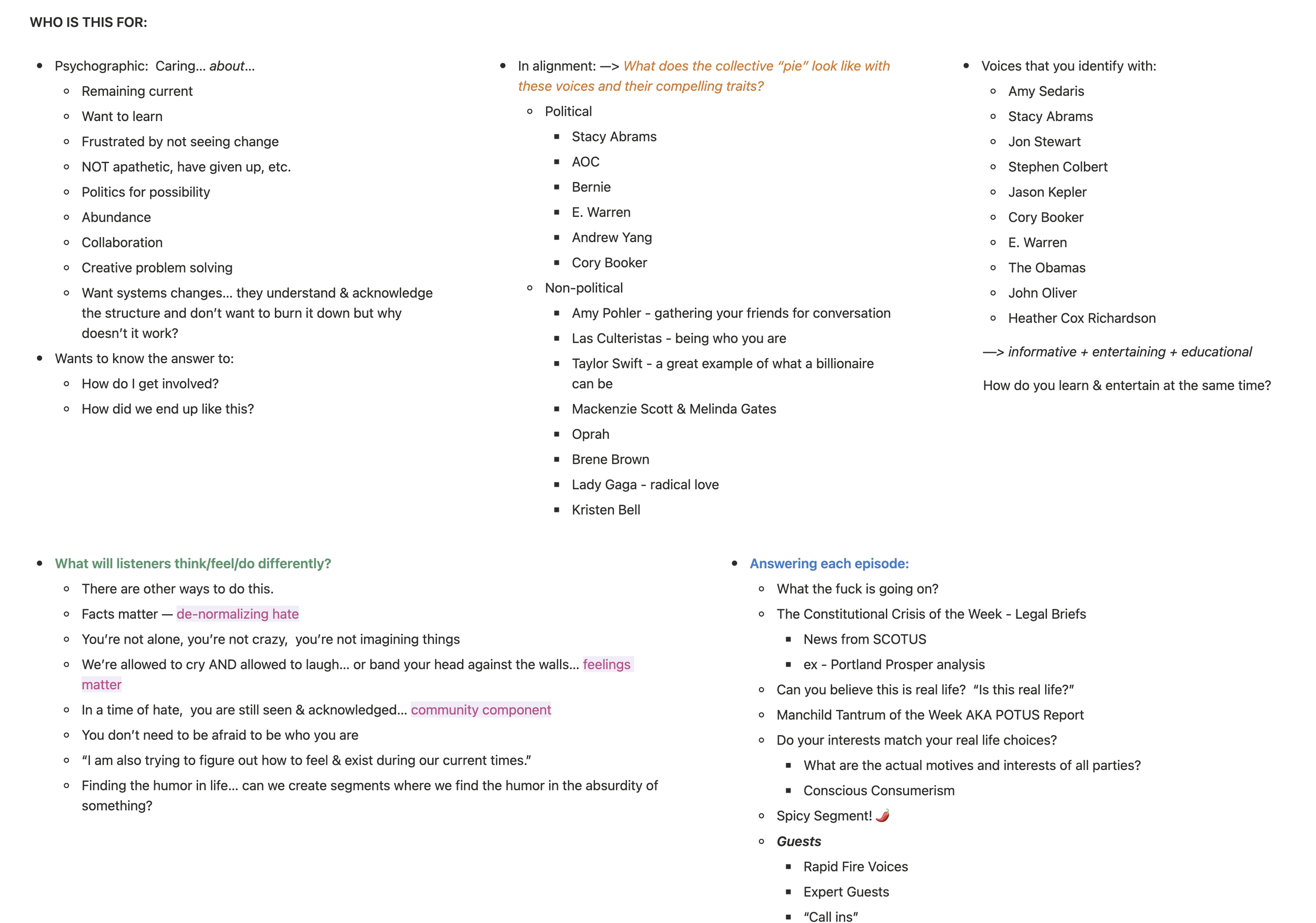
EARLY DEVELOPMENT NOTES · 2025
Before All American Why had a title, SMG mapped the influences, worldview, emotional needs, and media habits that would eventually shape the show's audience and editorial voice.
Michael didn't suffer from a shortage of ideas.
He had the opposite problem.
SMG took a sprawling inventory of political questions, cultural observations, guest possibilities, recurring bits, civic issues, personal curiosities, and “wait, what if we did THIS?” ideas... and developed an editorial architecture capable of holding them.
Eight major editorial territories gave future ideas somewhere to belong without turning every episode into everything everywhere all at once:
Government, Civics & Structural Power
Economic Justice & Cost of Living
Health, Neurodiversity & Mental Wellness
Technology, AI & Disinformation
Identity, Rights & Culture Wars
Environment & Planetary Health
Culture, Pop & Personality-Driven
Work, Labor & The System
Good development doesn't kill creative ideas.
It gives them somewhere to go.
Creative chaos needed a container.
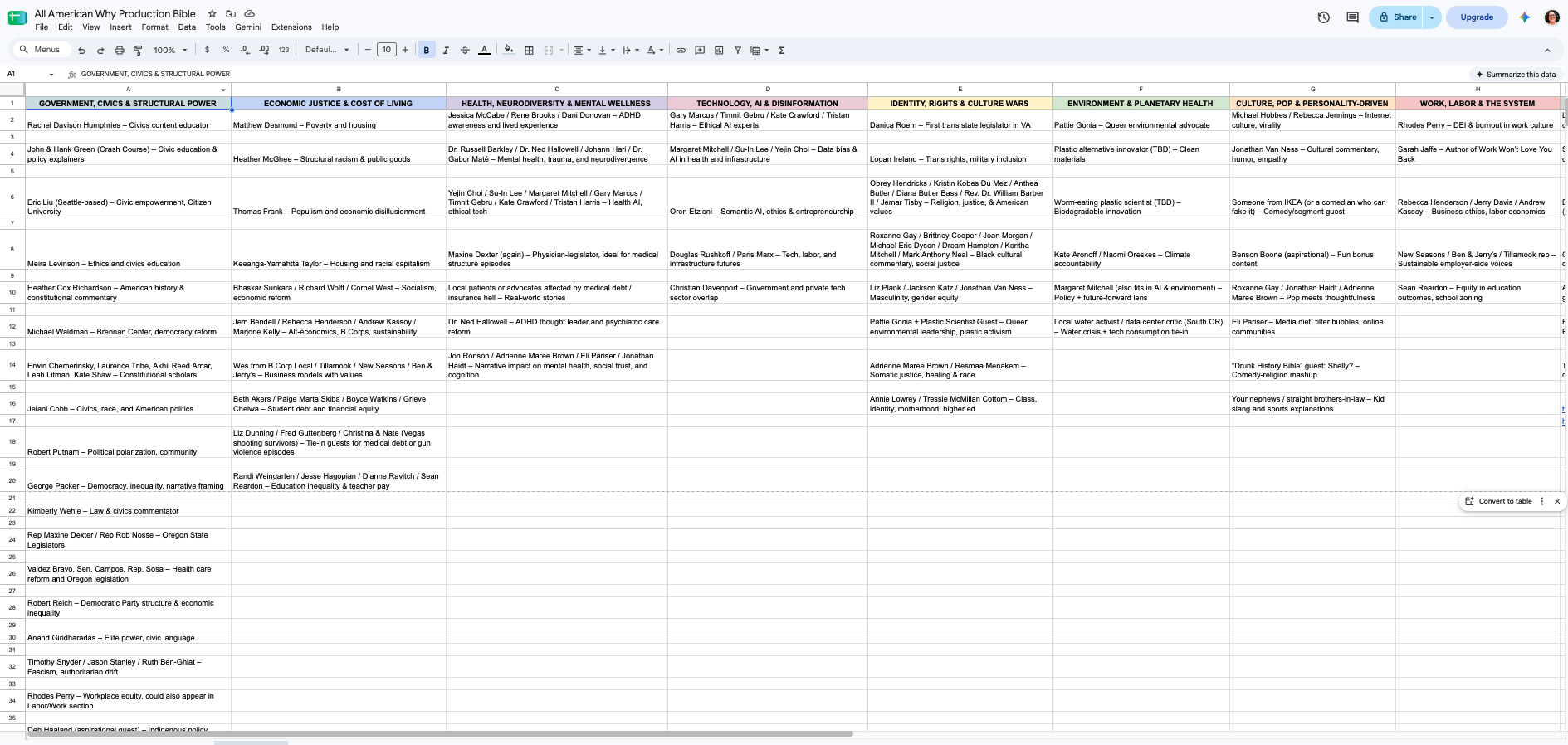
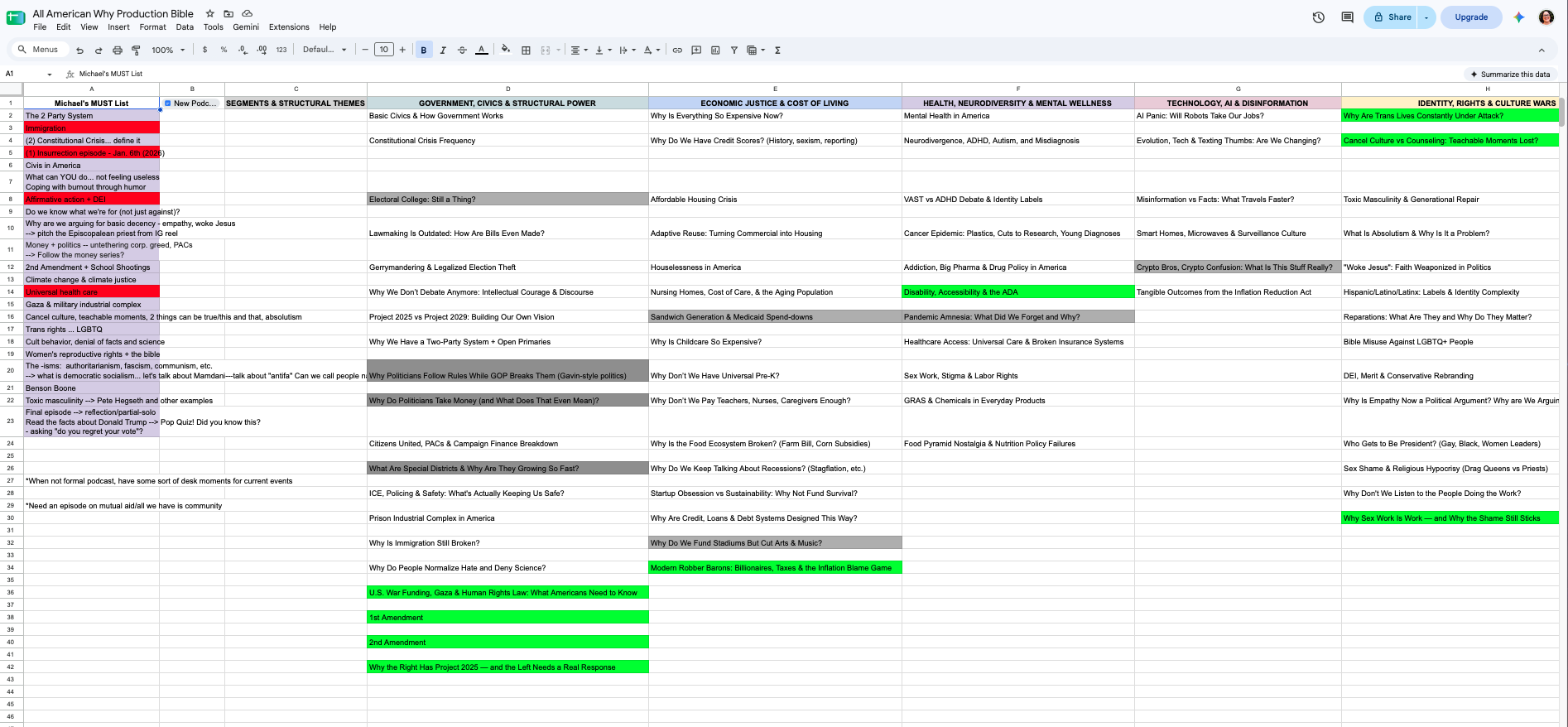
EDITORIAL ARCHITECTURE · PRODUCTION BIBLE
Ideas weren't discarded simply because they couldn't fit into the next episode. They were organized into a larger editorial system the show could keep drawing from.
A sixty-minute show cannot contain every good idea you've ever had.
Rather than flatten Michael's ambition, SMG turned it into a modular format.
Some elements would remain consistent: the opening, Michael's central question, contextual research, the guest conversation, and the close.
Other pieces could rotate according to the subject... political commentary, current events, cultural observations, comedy, and recurring segments.
The result was structure without sameness.
Michael didn't have to invent a new podcast every time he sat down to make an episode.
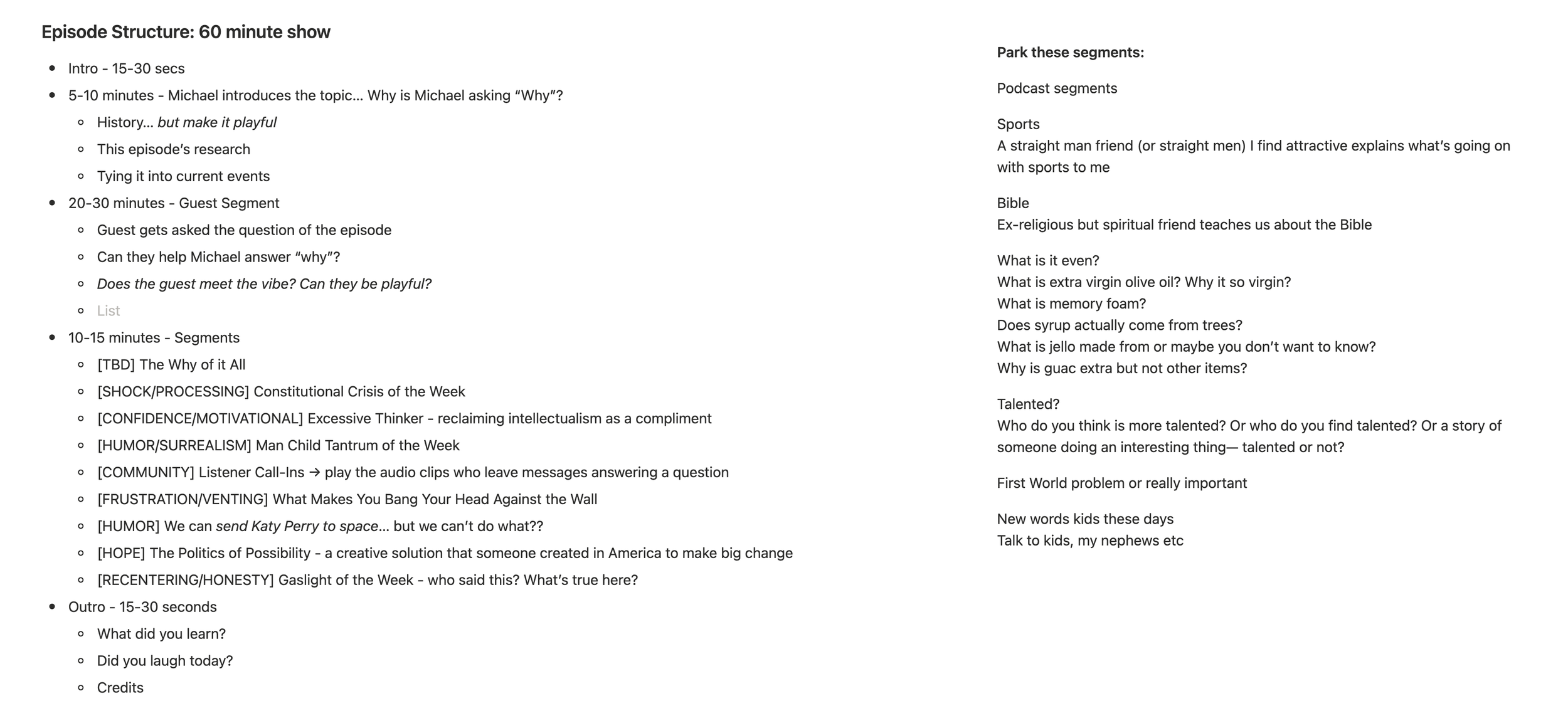
The episode architecture created enough consistency to make the show producible while leaving room for topical commentary, interviews, and humor.
It gives the interesting parts something to push against.
A repeatable format doesn't make a show boring.
Serious ideas still needed room to be funny.
The format wasn't designed to turn every political question into an hour-long lecture.
SMG developed a library of modular segments that could bring humor, audience participation, cultural commentary, and personality into the show without derailing the central conversation.
Ideas included:
Constitutional Crisis of the Week
Gaslight of the Week
The Politics of Possibility
What Would You Throw at the Wall?
First World Problem or Actually Important?
Expert Hot Seat
IKEA or Nonsense?
If You Won Powerball... What Would You Fix?
Crypto Bro Market Update
Lukewarm Opinions
The point wasn't to cram them all into every episode.
The point was to create an editorial playground Michael could keep returning to.
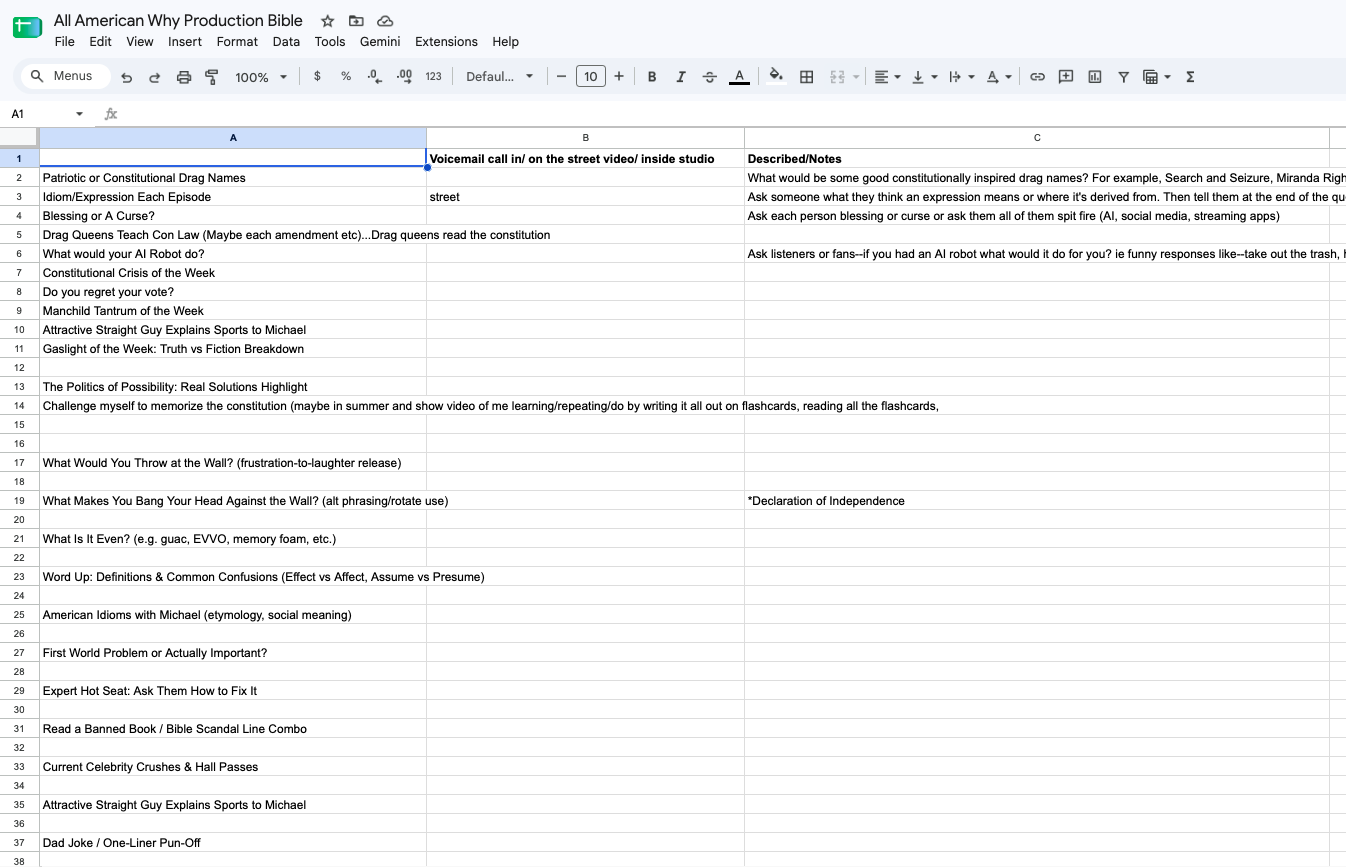
RECURRING SEGMENT DEVELOPMENT
A modular format let the show move between serious civic conversations, cultural commentary, humor, and audience participation without losing its identity.
All American Why didn't exist when the project began.
Early possibilities included Excessive Thinker, Reasonably Upset, One Nation, Underwhelmed, Informed & Agitated, and others.
As the positioning sharpened, Michael ultimately landed on All American Why... a name that captured the editorial device already sitting at the center of the show.
Every episode begins with a question.
Why is this happening?
Why does it work this way?
Why haven't we solved it?
The title wasn't the strategy.e title worked because the strategy already existed underneath it.
Even the name came out of development.
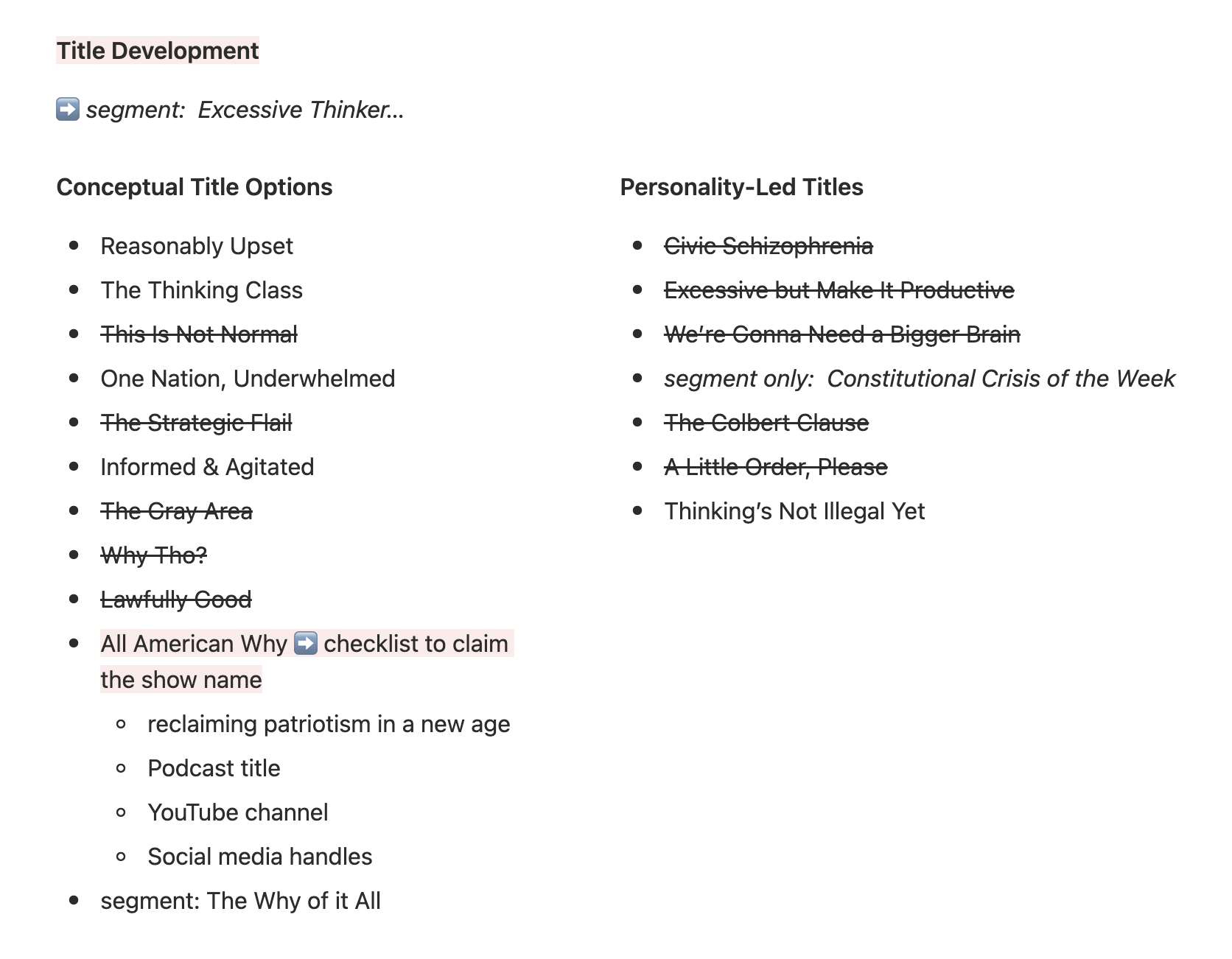
TITLE DEVELOPMENT
The name emerged after the show's audience, purpose, tone, and central editorial device had already begun taking shape.
A good idea doesn't automatically make someone a good host.
Michael brought professional expertise, political experience, natural curiosity, strong opinions, and access to an unusually interesting network.
Hosting required a different set of muscles.
SMG coached Michael through episode research, scripting, guest preparation, interviewing, storytelling, microphone technique, and the mechanics of moving an audience through a conversation without letting every interesting tangent become the episode.
We developed script templates and repeatable preparation systems so he wasn't staring at a blank document every time he needed to record.
And we worked on something considerably less glamorous:
getting out of his own head long enough to hit record.
Because talent development isn't only about what happens once the microphone turns on.
Sometimes it's about developing the habits required to get there.
A dream guest list and a booking strategy are not the same thing.
Michael had an impressive list of people he wanted on the show.
Some were already in his network.
Some were authors, experts, and public thinkers who could realistically be pitched.
Others were recognizable public figures with professional representation, booking processes, and no particular reason to appear on a media property that hadn't launched yet.
SMG helped separate:
PEOPLE WE CAN INVITE NOW
PEOPLE WE CAN PITCH
PEOPLE WE EARN ACCESS TO LATER
A guest strategy isn't a wishlist.
It's a relationship between access, relevance, timing, audience value, and the credibility your media property has earned so far.
We weren't preparing Michael to record three episodes.
We were building a show he wouldn't have to reinvent every week.
SMG created the production architecture around All American Why... episode script templates, guest-booking workflow, guest asset management, agreements, show notes, transcripts, raw and edited media organization, social assets, and a production bible tying the system together.
The editorial calendar extended far beyond premiere week, with future episode concepts, potential guests, research angles, recording and publication dates, guest status, scripts, production assets, social content, and newsletter support mapped into the system.
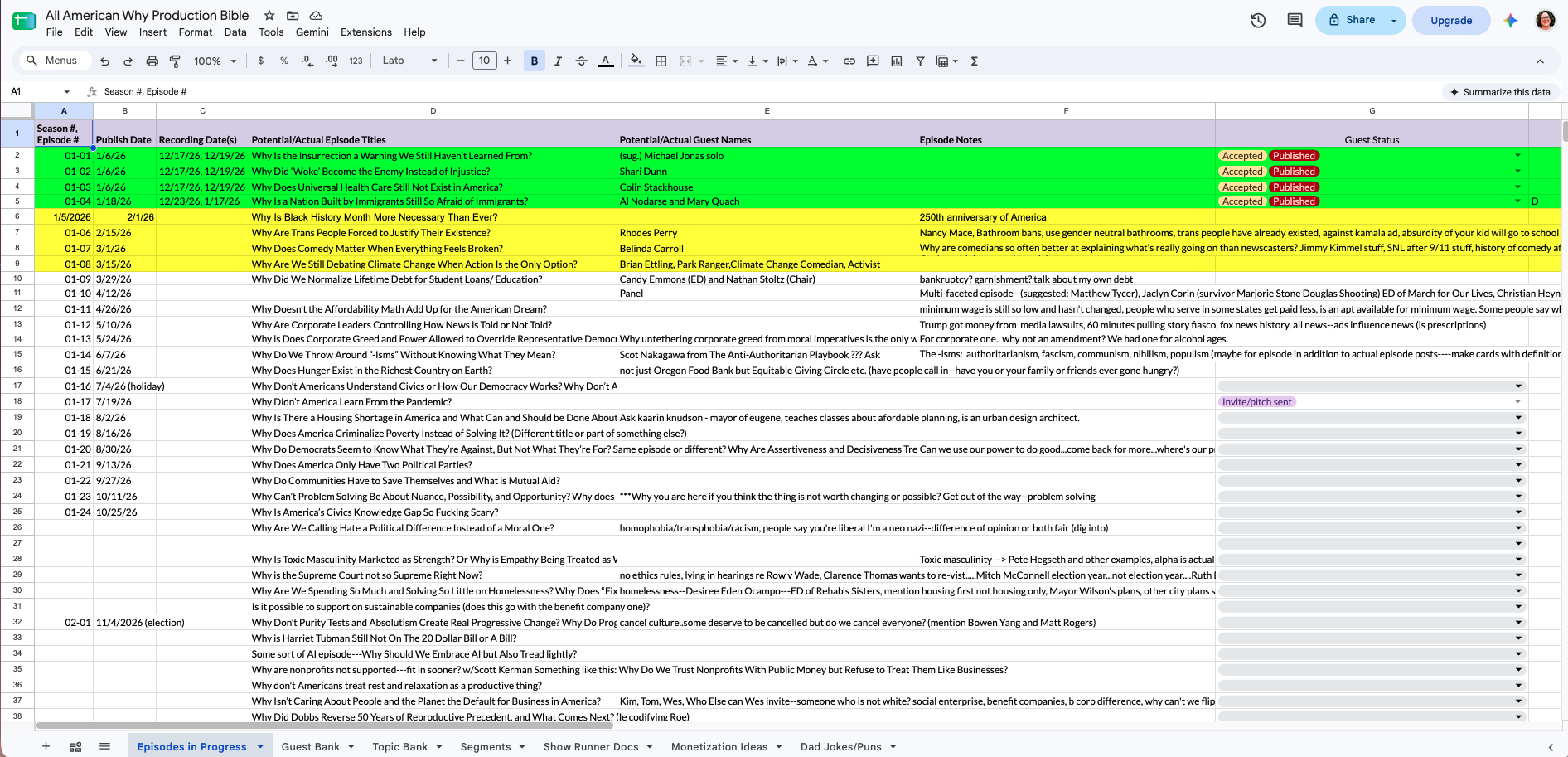
PRODUCTION BIBLE · EDITORIAL RUNWAY
The premiere was three episodes. The development work extended considerably further.
The original plan was bigger.
The executable plan was better.
SMG originally developed a five-episode premiere week: one new episode every weekday, followed by a regular weekly cadence.
But as production approached, another part of development became increasingly important.
Readiness.
Recording dates moved.
Guest outreach stalled.
The scope that looked exciting on paper began creating enough friction that launching at all was becoming the bigger risk.
So we changed the plan.
Five premiere episodes became three.
Not because the vision got smaller.
Because a launch you can execute is worth considerably more than an ambitious launch that never happens.
Michael chose three strong opening episodes:
EPISODE ONE
Michael Jonas
A solo introduction to All American Why
EPISODE TWO
Shari Dunn
Author of Qualified: How Competency Checking & Race Collide at Work
EPISODE THREE
Collin Stackhouse
Healthcare for All Oregon
The podcast was only the first format.
SMG's development work extended beyond individual episodes.
The production bible explored how All American Why could eventually expand through recurring language, audience identity, sponsorships, merchandise, speaking, community initiatives, live engagement, voter outreach, and even future publishing.
Not because every idea needed to become a product immediately.
Because a media property becomes considerably more valuable when its identity can travel beyond a single feed.
We weren't planning content.
We were developing a world the content could belong to.
Months of positioning, audience research, format development, scripting, host coaching, guest strategy, editorial planning, and production architecture eventually became what all that invisible work was designed to create:
a real show.
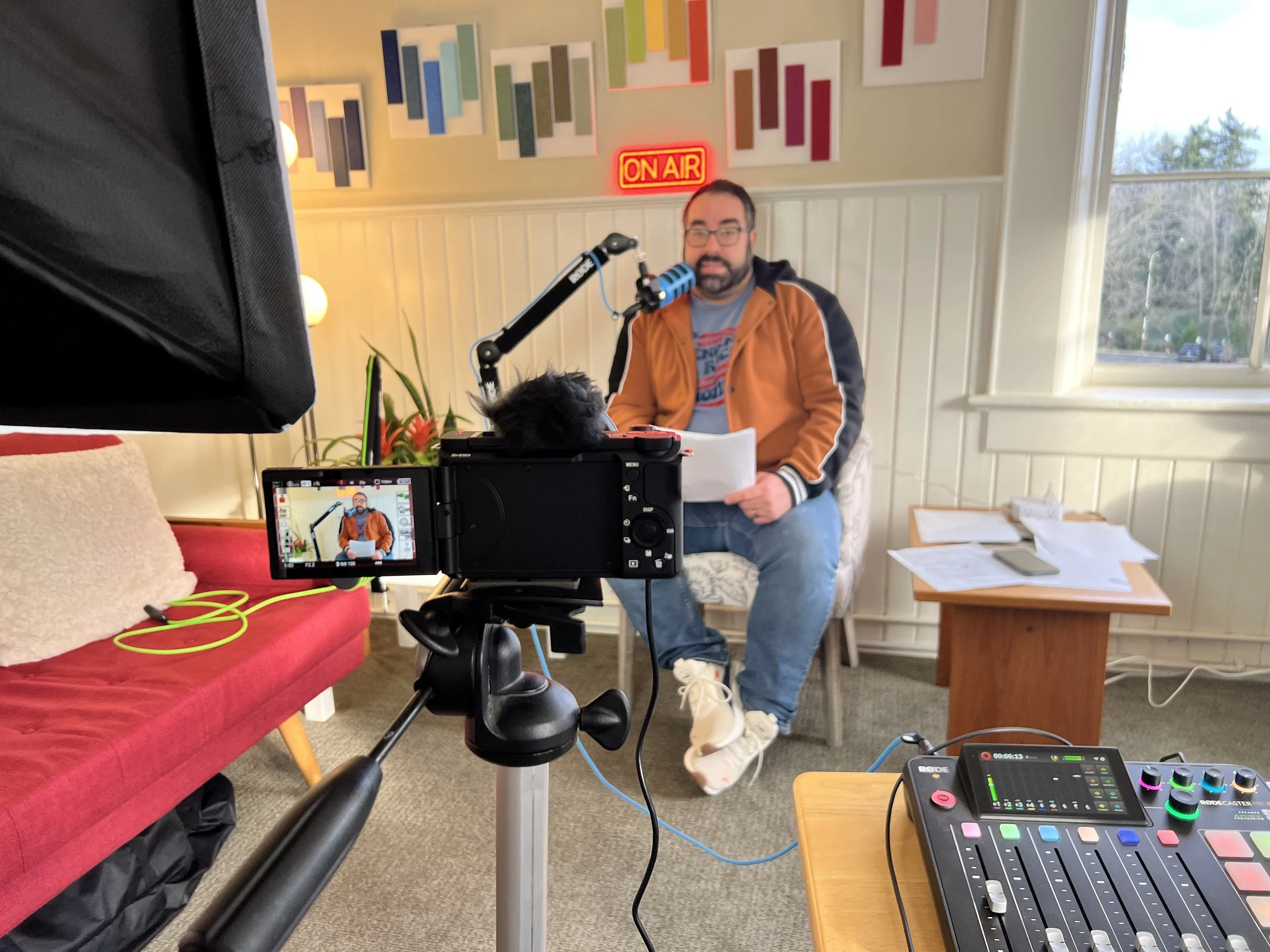
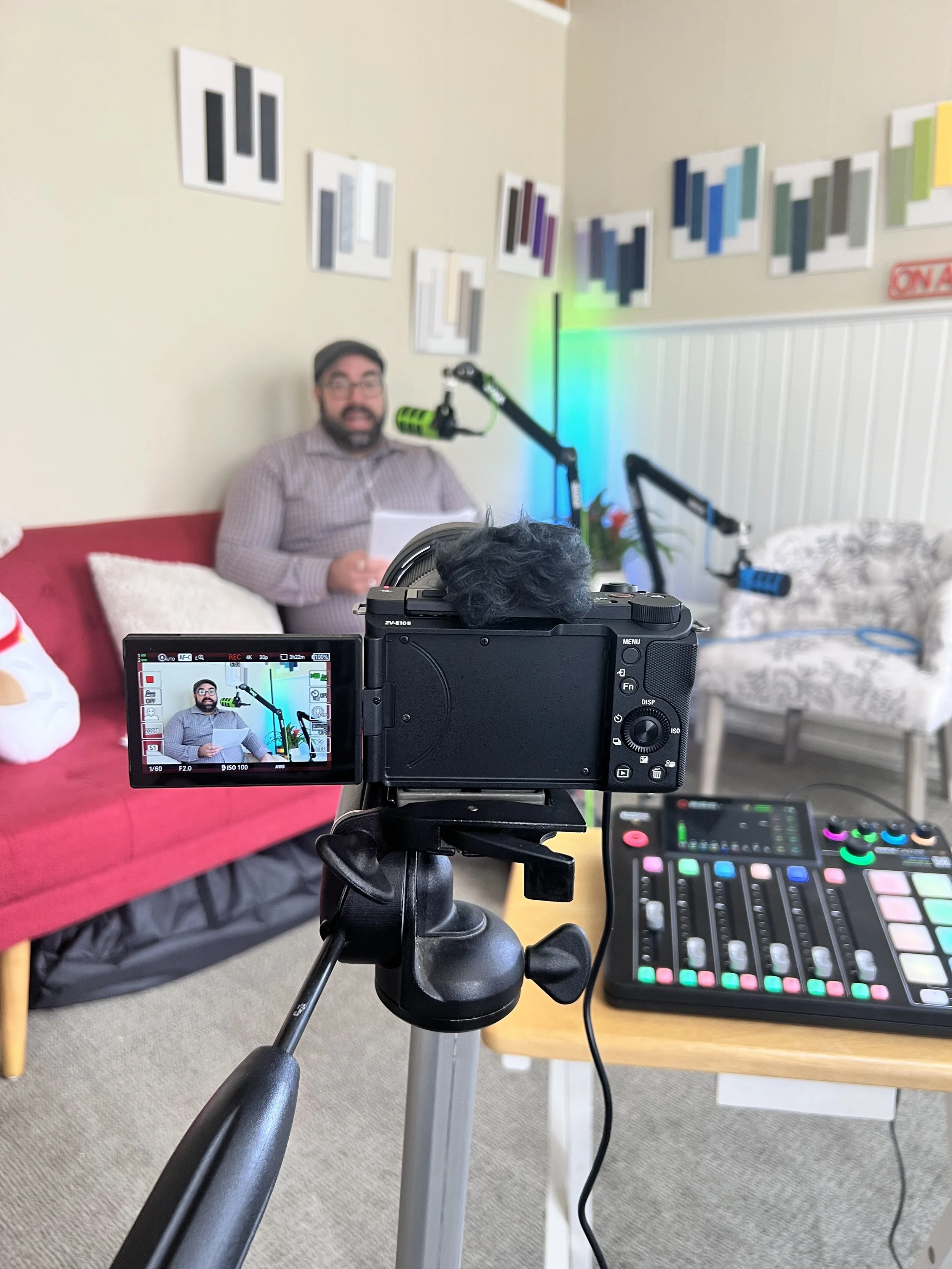
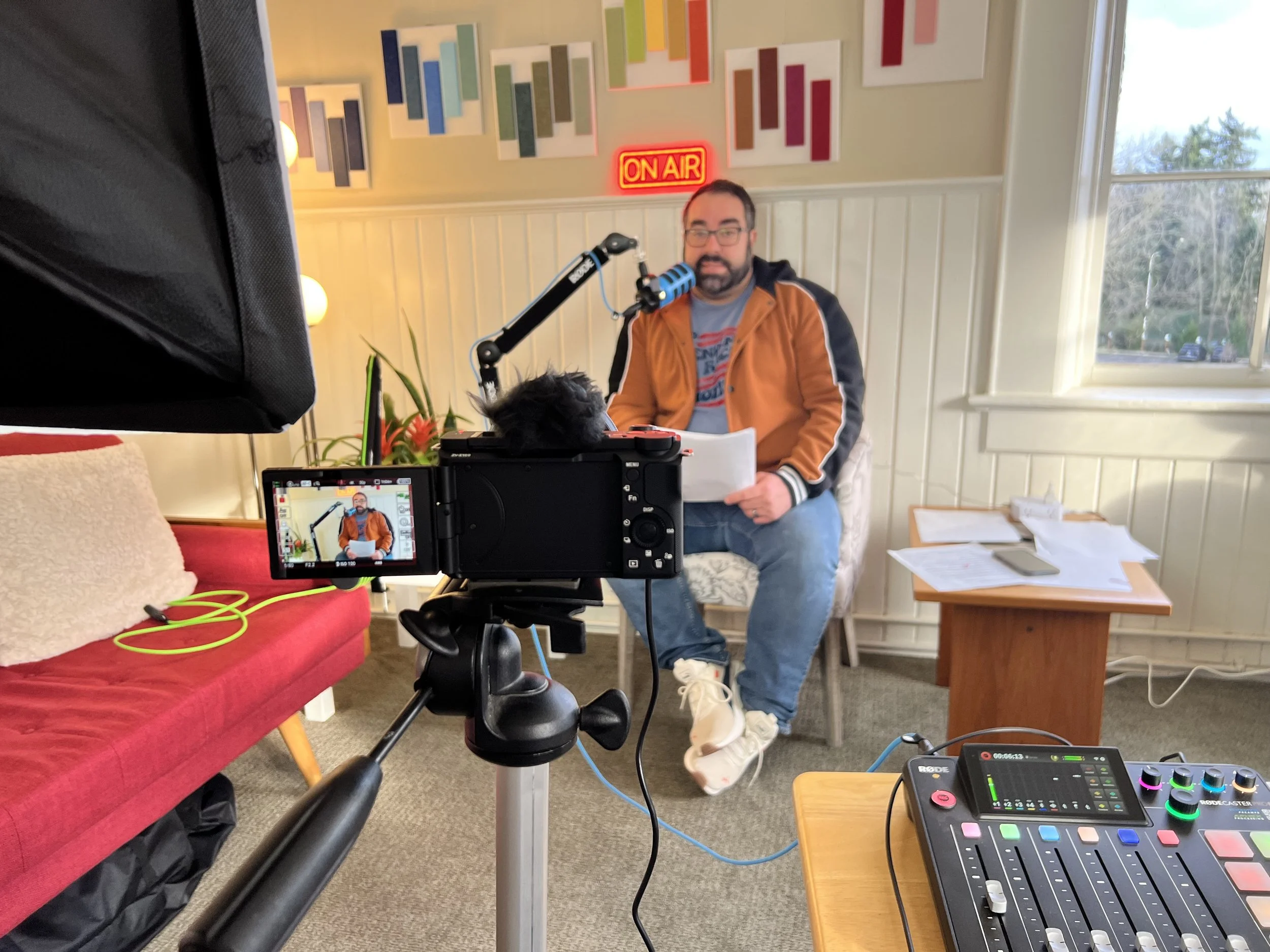
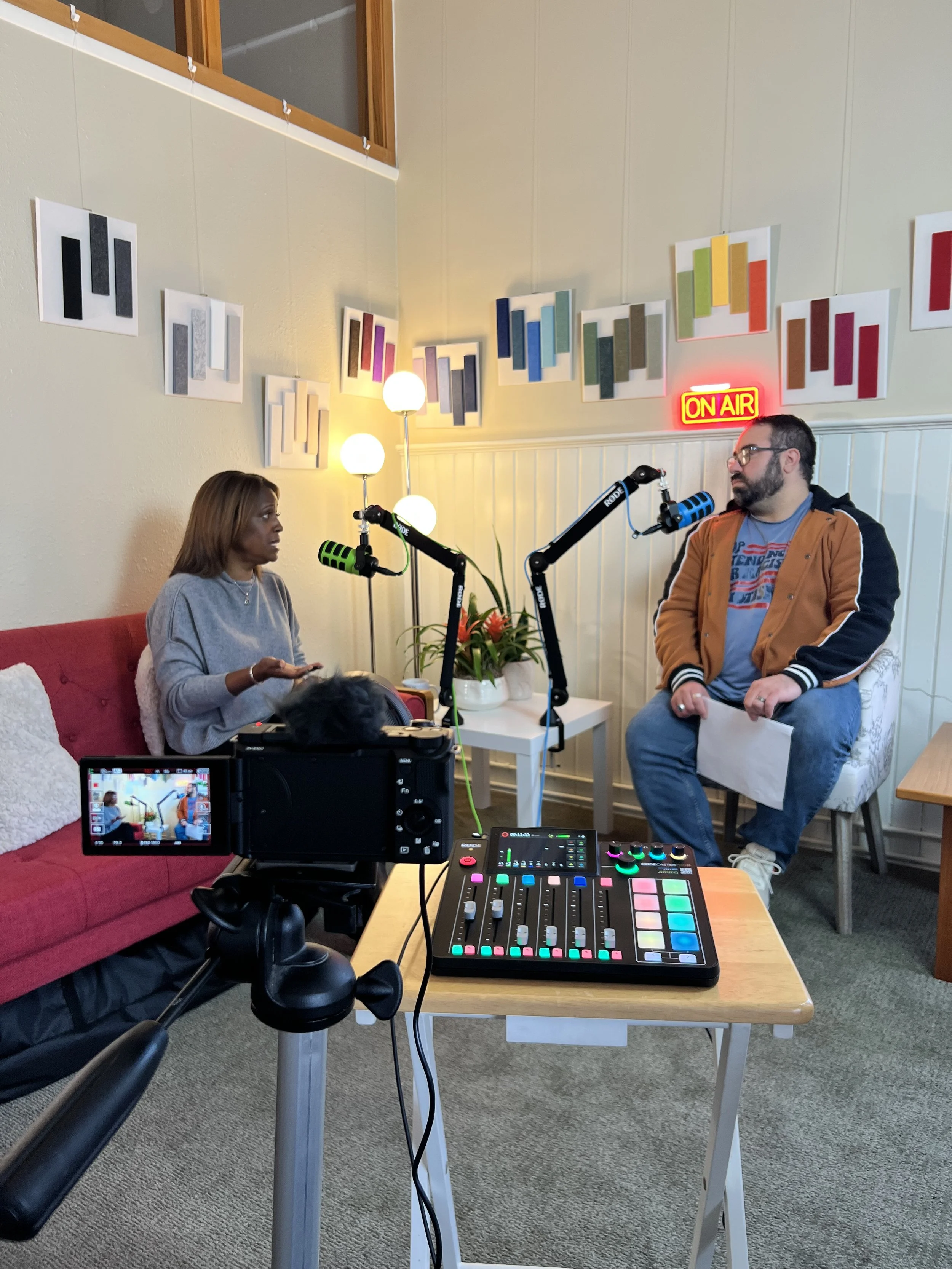
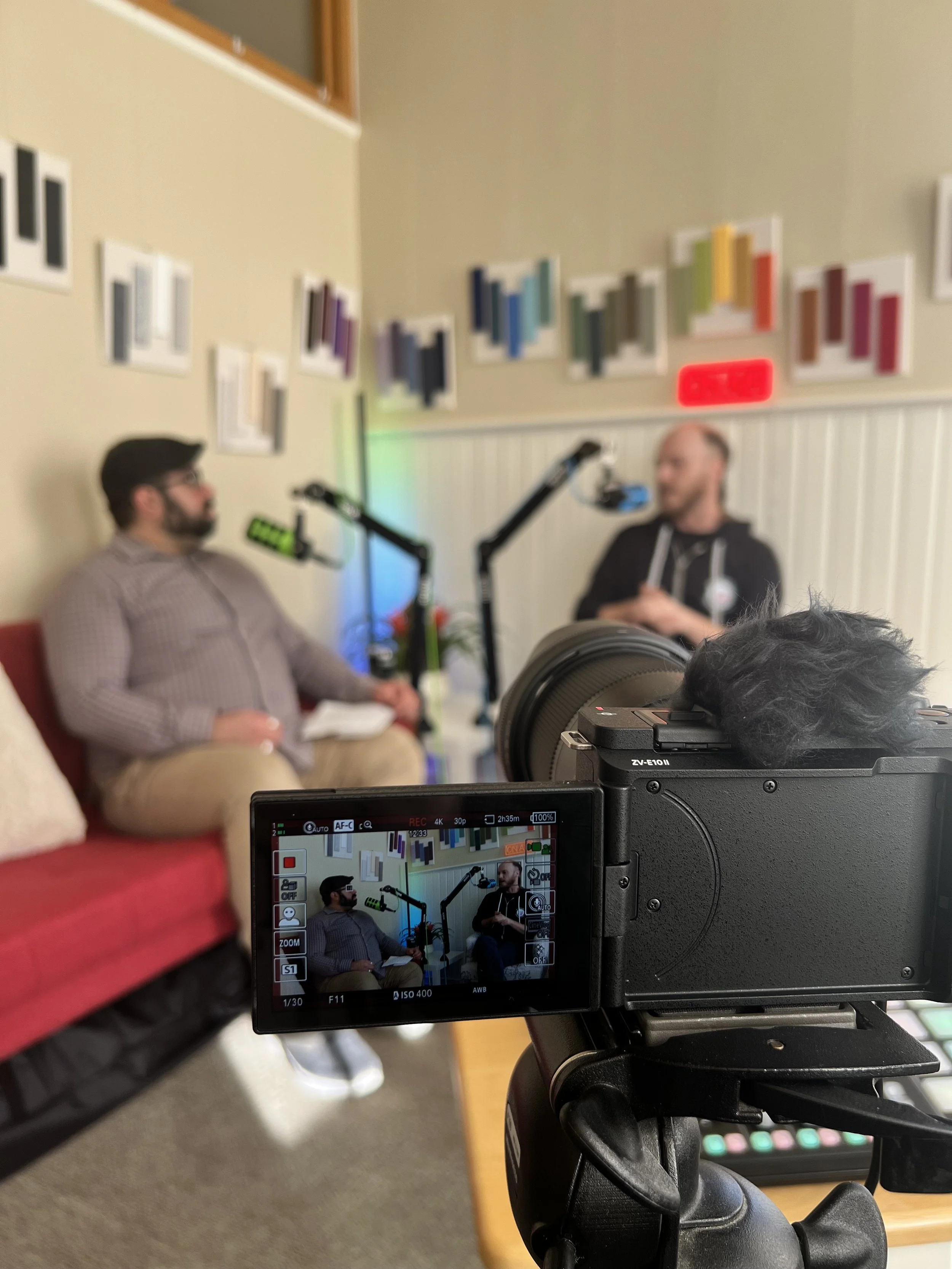
Michael recorded the All American Why premiere at Sasquatch Media Grounds in audio and video.
SMG executive produced the premiere recordings and delivered the launch foundation the show would use going forward.
And then it became real.
This wasn't “help me start a podcast.”
SHOW DEVELOPMENT
Positioning · audience · premise · editorial POV · naming development
FORMAT DEVELOPMENT
Episode structure · recurring segments · script templates · editorial flexibility
GUEST STRATEGY
Guest tiers · outreach systems · booking templates · preparation workflow
LAUNCH STRATEGY
Premiere arc · trailer · first-quarter planning · publishing runway
EDITORIAL ARCHITECTURE
Content territories · episode runway · recurring concepts · IP development
TALENT DEVELOPMENT
Research · scripting · interviewing · hosting · storytelling · microphone technique
PRODUCTION SYSTEMS
Production bible · guest workflow · asset management · studio workflow · audio + video planning
EXECUTIVE PRODUCTION
Episode preparation · recording direction · launch-week production
SMG's assignment was to turn an idea into a launchable media property.
We did.
What happened next taught us something just as valuable.
Act Two
Launching wasn't the hard part.
All American Why launched publicly on January 6, 2026 with a developed premise, professional premiere episodes, repeatable format, guest systems, production workflows, and an editorial runway designed to carry the show forward.
Then came the part nobody can produce for you.
Consistency.
Researching again.
Booking again.
Preparing again.
Recording again.
Publishing again.
Promoting when the numbers aren't exciting yet.
Showing up when nobody is waiting outside the studio screaming your name.
Doing the work long enough for an audience to develop a habit around it.
Media infrastructure can reduce friction.
It cannot manufacture consistency.
Wanting visibility and being ready for visibility are different things.
Most new creators don't arrive with a fully formed media strategy.
They arrive with references.
The podcasts they love.
The hosts they admire.
The creators whose careers look exciting from the outside.
That's normal.
What we rarely see is everything underneath those careers... years of repetition, professional development, teams, representation, production budgets, booking relationships, failed experiments, boring administrative work, and hundreds or thousands of hours spent getting better when very few people were watching.
Wanting the outcome is not the same thing as being ready for the operating system that creates it.
Michael had intelligence… as well as
Ideas.
Professional credibility.
A strong network.
A point of view.
And a developed show with real potential.
Sustaining it required something different:
CAPACITY · CONSISTENCY · COMMERCIAL COMMITMENT · REPETITION
THE READINESS MODEL
Before you scale production, ask what is actually ready.
IDEA READINESS
Is there something worth saying?
↓
TALENT READINESS
Can you communicate it effectively?
↓
PRODUCTION READINESS
Can you reliably create the media?
↓
BUSINESS READINESS
Can you support, distribute, promote, and sustain it long enough to work?
Production can solve a production problem.
It cannot solve a readiness problem.
A creator can have an excellent idea, meaningful expertise, strong connections, and genuine potential... and still need development before an ongoing production schedule makes business sense.
That's not failure.
It's a stage of development.
Sometimes the smartest next move isn't producing more media.
It's building the creator who will eventually be responsible for sustaining it.
WHAT HAPPENED NEXT
The show continued.
The cadence didn't compound.
Since its January 2026 premiere, All American Why has continued publishing independently of SMG.
Michael retained the show's original premise, editorial architecture, interview format, premiere episodes, trailer, and foundational systems developed during the engagement.
Production later moved outside SMG and publishing became more intermittent.
That gives us a result worth talking about:
The show survived.
But the consistent production cadence required to build repeated audience behavior never fully materialized during the period covered by this case study.
A successful launch can prove that a media property exists.
Only sustained execution can discover what that property might become.
WHAT ALL AMERICAN WHY TAUGHT US
Not everyone who needs media development needs production yet.
This project sharpened an important distinction inside SMG.
Development and production are different stages.
Sometimes a creator needs cameras, microphones, editing, and distribution.
Sometimes they need help developing the concept, their voice, their judgment, their systems, and their ability to execute consistently.
And sometimes spending thousands of dollars on production before those foundations exist is simply an expensive way to discover that you weren't ready.
Knowing which stage you're in matters.
The camera is rarely the actual problem.
The real question is what the camera is supposed to solve.
CASE STUDY UPDATED · SEPTEMBER 2026
The architecture is still there.
All American Why remains publicly available and continues to publish.
Its central “Why?” premise, combination of civic questions and cultural conversation, guest-driven format, and foundational premiere content remain recognizable parts of the property today.
That's useful evidence of the development work.
But this project left SMG with something even more valuable:
Building something worth launching and building the capacity to sustain it are two different jobs.
We now design for both.
HAVE THE IDEA BUT NOT THE OPERATING SYSTEM?
You might not need to launch yet.
And finding that out before you spend thousands of dollars producing media is considerably cheaper than discovering it afterward.
The Dojo is SMG's fractional talent-management container for founders and creators developing the strategy, systems, judgment, consistency, and commercial thinking required to make media worth producing.
Already have the foundation and need production?
TALK TO SMG →